


 Home
Home
Capillary Tube Sealing for Refrigeration Sensors: Ultrasonic Tube Sealer Guide | Borude
September. 21,2026
Every mechanical thermostat and many temperature sensors fitted to refrigerators, freezers, water heaters, display cabinets and commercial cold rooms depends on a slender copper capillary tube. The capillary carries a sensing charge between the bulb and the power element, and the factory-made seal at its tail end is the component's last line of defense against leakage. Yet a large share of sensor and thermostat manufacturers still close these tubes with open flames or solder. This guide explains why an ultrasonic tube sealer has become the preferred capillary tube sealing machine for high-volume sensor lines, how the process works, and what to verify before you invest.
What the Capillary Seal Does in a Sensor or Thermostat
In a fluid-charged thermostat, the capillary tube links the sensing bulb to a diaphragm or bellows that actuates an electrical contact. In many fixed-temperature sensors, the tube is evacuated or filled with a precise charge before the tail end is permanently closed. That single crimped-and-welded point has to stay hermetic for the service life of the appliance — ten years or more in a compressor compartment subject to heat and vibration.
A marginal seal causes problems that surface long after shipment: slow loss of the sensing charge, switching-point drift, nuisance trips or failures to protect, and warranty returns that are far more expensive to handle than the seal itself. For a sensor plant running thousands of units per day, the seal also has to be identical every cycle — the same crimp depth, the same wall thickness, the same leak-tightness — regardless of which operator is on the line. That combination of hermeticity and repeatability is exactly where traditional flame methods struggle.
Why Flame and Solder Sealing Fall Short on Sensor Capillaries
Flame sealing a small-diameter copper tube looks simple, but it concentrates several risks at the worst possible location — a few millimeters from the sensing charge:
• Heat input. A torch heats a wide zone of the tube. Conducted heat raises the pressure of the charge inside during the seal, and an overheated collar can distort or crack as it cools.
• Oxidation and fouling. Flame and flux leave oxides and residue on the hot metal, and loose particles can migrate toward the bore.
• Operator dependency. Seal quality follows the operator's hand: flame dwell time, flame position and solder quantity all vary between shifts.
• Compliance pressure. Open flames now require hot-work permits and fire watch procedures in many plants, and factories handling flammable refrigerants such as R290 and R600a are systematically restricting ignition sources anywhere near charged circuits.
• Micro-leaks. A single overheated spot or a solder joint with a void can weep under vibration, a defect that often escapes end-of-line testing and appears as a field failure.

Flameless sealing of copper tubes for refrigeration component manufacturing.
How Ultrasonic Capillary Tube Sealing Works
An ultrasonic capillary tube sealing machine closes the tube by solid-state deformation rather than melting. The tube end is clamped between a vibrating sonotrode and an anvil; high-frequency vibrations — typically in the tens of kilohertz — disperse surface oxide films and force the metal-to-metal contact that forms a cold weld. The same cycle seals the collar and cuts the tail in one motion, so there is no secondary cropping step.
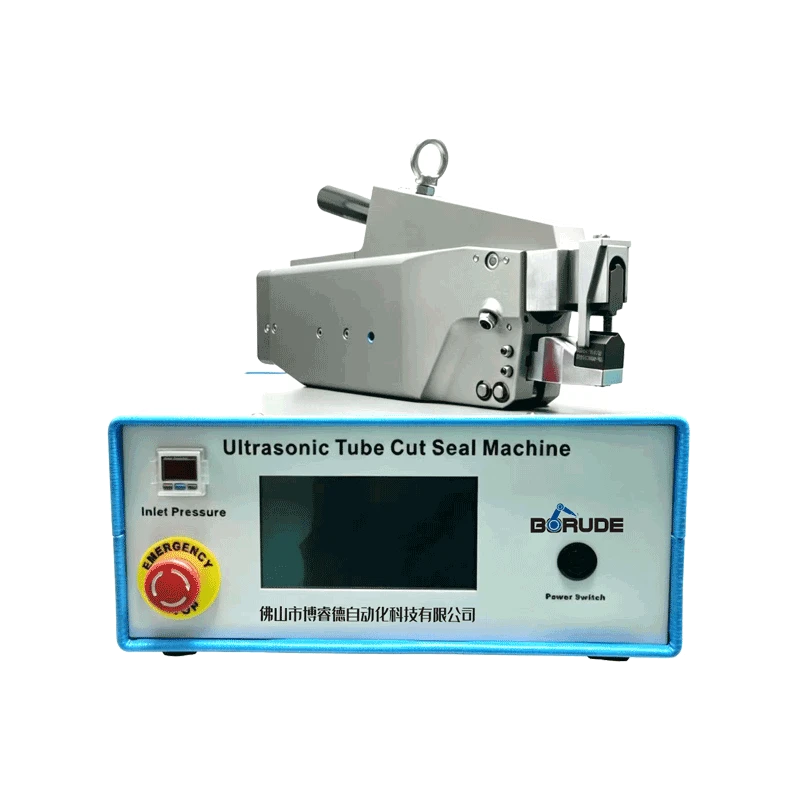
Because nothing is melted, the tube stays close to ambient temperature: no flux, no filler, no flame, no oxidation ring inside the bore, and no heat soak into the sensing charge. The seal wall thickness is controlled by the tooling and machine parameters instead of by the operator's eye. On a smart-class machine such as Borude's BRD-2A, every cycle is monitored — seal thickness, air pressure and frequency are tracked and alarmed if they drift out of range — and up to 20 parameter groups can be stored for different tube sizes or products. Power draw is roughly one-thirtieth of a comparable resistance welding process, and the machine runs from an ordinary 220 V AC / 50 Hz supply with compressed air at just 0.45–0.6 kgf/cm², which makes it easy to place directly at the sensor assembly line.

BRD-2A smart edition — process-monitored ultrasonic capillary tube sealing machine.
Buying Criteria for a Sensor-Line Tube Sealing Machine
Sensor and thermostat plants evaluate capillary sealing equipment against a short list of hard requirements. Use the table below as an RFQ checklist:
| Criterion | What to Check | Why It Matters |
|---|---|---|
| Tube range | Small-diameter copper and aluminum tubing used on your SKUs | One machine covers thermostat and sensor variants |
| Seal integrity | Leak and burst test reports; consistent collar wall thickness | Hermetic service life of 10+ years |
| Cycle time | Seal + cut completed per cycle, seconds per piece | Keeps pace with line takt at thousands of units/day |
| Process monitoring | Thickness / pressure / frequency tracking with alarms | Traceability and instant defect detection |
| Utilities | 220 V / 50 Hz supply; air at 0.45–0.6 kgf/cm² | No special electrical or gas infrastructure |
| Tooling life | Welding head ~60,000 cycles; tip ~6,000 cycles per point | Predictable consumable and maintenance planning |
| Data interface | RS232 port, stored parameter groups (e.g. 20 sets) | QC records and fast product changeover |
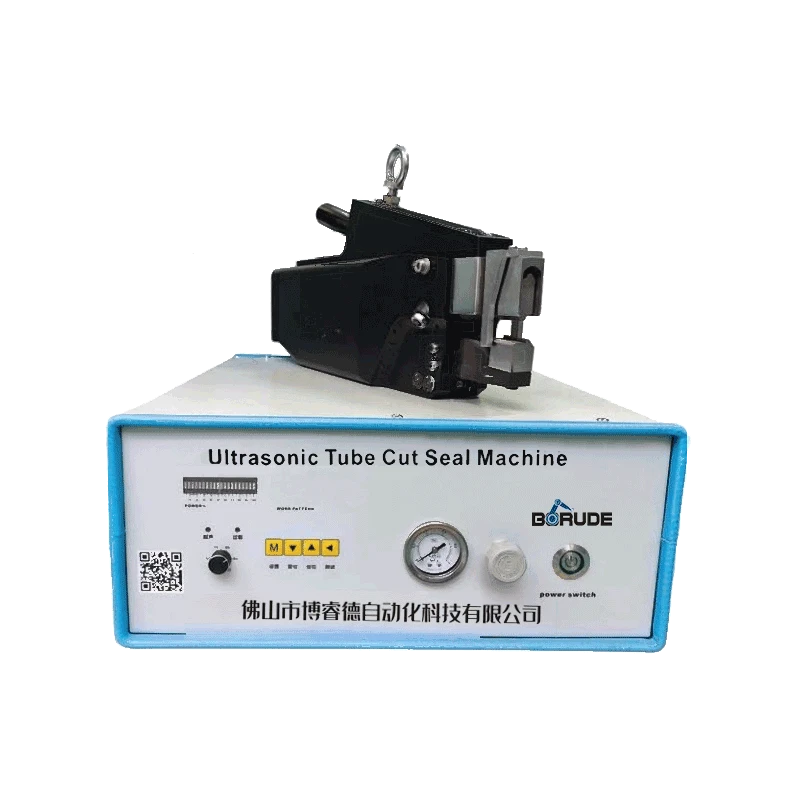
If budgets are tight and product variants are few, a basic edition machine such as the BRD-2M copper tube cut and seal machine delivers the same flameless solid-state seal without the monitoring layer; plants that need audit trails and multi-product storage step up to the smart edition. Either way, confirm the supplier can seal your actual capillary samples before you sign — not a similar tube from their demo shelf.

BRD-2M basic edition for straightforward capillary and connector tube sealing.
Why Sensor and Thermostat Manufacturers Choose Borude
Borude (Foshan Borui De Automation Technology Co., Ltd.) builds ultrasonic metal welding and tube sealing equipment in Foshan, Guangdong — one of China's densest refrigeration and appliance manufacturing clusters. That location matters for sensor makers: the same factory district supplies compressor plants, thermostat manufacturers and appliance OEMs, and Borude's ultrasonic welding machines have been refined on exactly these production lines.
Buyers typically select Borude for three practical reasons. First, both the smart tube sealer and the basic edition are proven on refrigeration-grade copper tubing and ship with leak-test documentation. Second, the machines are compact bench units (the BRD-2A head weighs just 12.5 kg) that slot into existing sensor assembly benches without rebuilding the line. Third, Borude supports OEM and ODM customization — tooling sized to your capillary diameter, control interfaces and electrical standards matched to your market — so a machine ordered from China lands ready to run. Support covers commissioning guidance, tooling spare parts and parameter tuning for new tube specifications.
Ready to Replace Flame Sealing on Your Sensor Line?
Send us your capillary tube specification — outside diameter, wall thickness, material and monthly volume — and Borude will run trial seals on your samples and share the leak-test data. Contact Borude today for a quotation and sealing demonstration.
© 2026 Borude — Ultrasonic Metal Welding & Tube Sealing Equipment. All rights reserved.


