


 Home
Home
R290 Heat Pump Copper Tube Sealing: Ultrasonic Tube Sealer Buyer's Guide | Borude
September. 16,2026
Propane (R290) has become the refrigerant of choice for residential and commercial heat pumps, driven by tightening F-Gas rules in Europe, low-GWP targets in North America and Asia, and generous subsidy programs that reward natural refrigerant products. For heat pump OEMs and contract manufacturers, this shift changes one deceptively small step on the assembly line: how the copper process tubes are closed after evacuation and charging. This guide explains why R290 refrigeration tube sealing has moved away from flame brazing, how an ultrasonic tube sealer works, and what purchasing teams should compare before investing in a machine.
Why R290 Is Reshaping Heat Pump Production
R290 combines excellent thermodynamic performance with a GWP of around 3, making it compliant with the EU F-Gas Regulation and attractive under rebate schemes such as those tied to the REPOWEREU agenda. Monobloc air-to-water units, domestic hot water heat pumps and pool heaters increasingly ship with R290 charges. The trade-off is classification: R290 is an A3 refrigerant — highly flammable — and charge limits in occupied spaces push manufacturers toward larger outdoor units, bigger coils and, critically, stricter factory safety practices.
Every process that once tolerated an open flame now needs re-evaluation on an A3 line. Charging, leak testing and the final closing of copper capillary and process tubes sit at the center of that review, because they involve the moment when flammable refrigerant is already inside the circuit. Equipment buyers searching for a copper tube sealing machine manufacturer are therefore usually driven by a compliance audit, a new product introduction, or an incident-avoidance mandate from their EHS team.

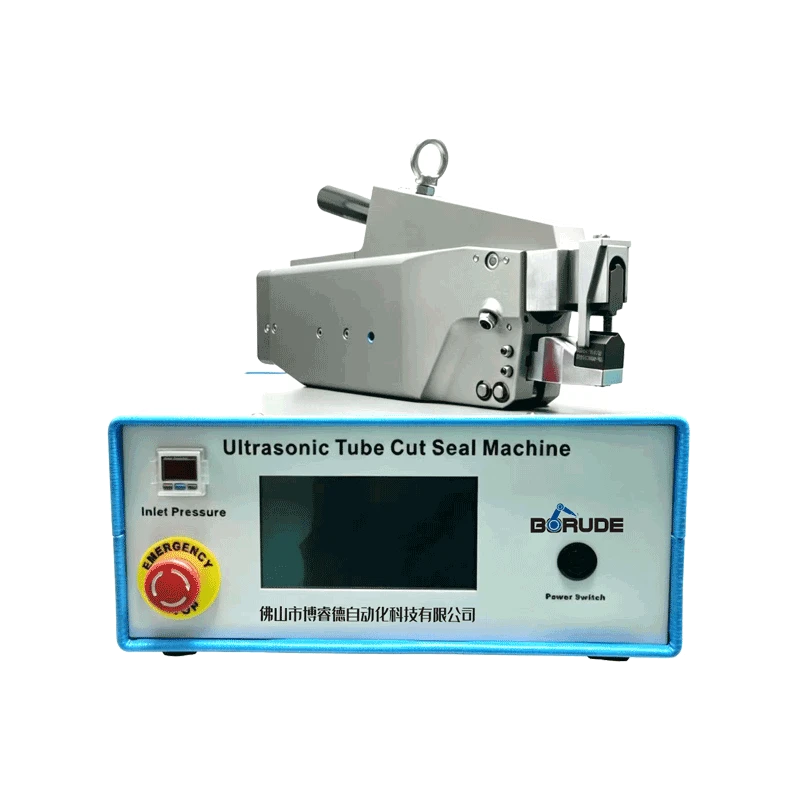
Borude smart edition ultrasonic tube cut & seal machine designed for R290/R600a refrigerant circuits
The Sealing Challenge on an R290 Heat Pump Line
After evacuation and charging, heat pump circuits are closed by pinching and sealing a copper process tube — typically 4 to 8 mm in diameter. Traditional flame brazing of this closure raises several problems that scale badly with R290:
- Ignition risk: An open flame or hot braze torch near a tube containing propane demands hot-work permits, fire watch procedures and dedicated safety zones on the line.
- Internal oxidation: Brazing heat oxidizes the tube bore. Oxide scale can migrate into expansion devices and compressors, and it complicates downstream leak testing.
- Operator dependence: Seal quality varies with torch skill, making first-pass yield and audit traceability harder to guarantee across shifts.
- Refrigerant compatibility: Repeated local heating can alter the temper of the copper and create micro-cracks that become long-term leak paths, a warranty risk on units guaranteed for 10+ years.
A modern ultrasonic tube sealer removes all four issues in one stroke, which is why appliance makers who converted their refrigerator lines to R600a years ago are now applying the same logic to heat pump production.
How Ultrasonic Copper Tube Sealing Works
Ultrasonic tube sealing is a solid-state process. A 20 kHz sonotrode vibrates against the copper tube while a shaped anvil clamps it with controlled force. The frictional vibration disperses surface oxides and creates a metallurgical cold weld between collapsed copper layers — no flame, no filler metal and no external heat. In the same clamping cycle the tooling cuts the tube tail clean off, so the operator performs cut and seal in one station.
Because the copper never melts and no ignition source is present, the process is inherently suitable for A3 refrigerant circuits. A typical seal takes one to two seconds, produces a leak-tight joint verified by pressure testing, and leaves a smooth, oxide-free bore. Borude's smart ultrasonic tube sealer adds closed-loop energy and amplitude monitoring, so every closure is logged and out-of-window welds are flagged automatically — a direct answer to the traceability expectations of heat pump OEM audits.

Ultrasonic sealing applied to copper process tubes in refrigeration and heat pump assembly
Flame Brazing vs Ultrasonic Sealing on an A3 Line
| Aspect | Flame Brazing | Ultrasonic Sealing |
|---|---|---|
| Ignition source near refrigerant | Open flame present | None — solid-state process |
| Filler and flux | Braze ring and flux required | No consumables |
| Tube bore condition | Oxidized by flame heat | Oxide-free, smooth bore |
| Typical closure time | 20–60 seconds with heating and cooling | 1–2 seconds per cycle |
| Operator certification | Certified brazer plus fire watch | Short training, push-button cycle |
| Process records | Manual inspection records | Weld-by-weld energy and force logs |
The table is not an argument to eliminate brazing everywhere — main heat exchanger and pipe assemblies still require it. The point is narrower and more practical: the final tube closure on an R290 circuit no longer needs a flame, and removing that flame simplifies safety zoning, staffing and quality documentation at the same time.
What Heat Pump OEMs Should Evaluate Before Buying
When comparing quotations for an ultrasonic copper tube sealing machine, purchasing and process engineers should align on these criteria:
- Tube range: Confirm the machine covers your capillary and process tube diameters (Borude machines handle the common 4–8 mm refrigeration range) and both hard-drawn and soft copper.
- Seal integrity data: Ask for burst and helium leak test reports on seals made with your actual tube stock, not generic samples.
- Process monitoring: Energy, amplitude and clamping force should be logged per weld with alarm limits, supporting IATF-style traceability on appliance lines.
- Tooling life and spares: Sonotrode and anvil service life determine cost per closure; request documented cycle counts and local spare-part availability.
- Line integration: Footprint, air supply requirements, I/O interfaces and cycle rates must match both manual stations and future automated layouts.
- Refrigerant-specific references: A supplier with installed R290/R600a machines can share field data that a general-purpose welder builder cannot.
For budget-sensitive pilot lines, Borude offers the basic edition tube sealing machine with the same ultrasonic sealing principle in a manual, cost-optimized configuration, upgradeable as volumes grow.

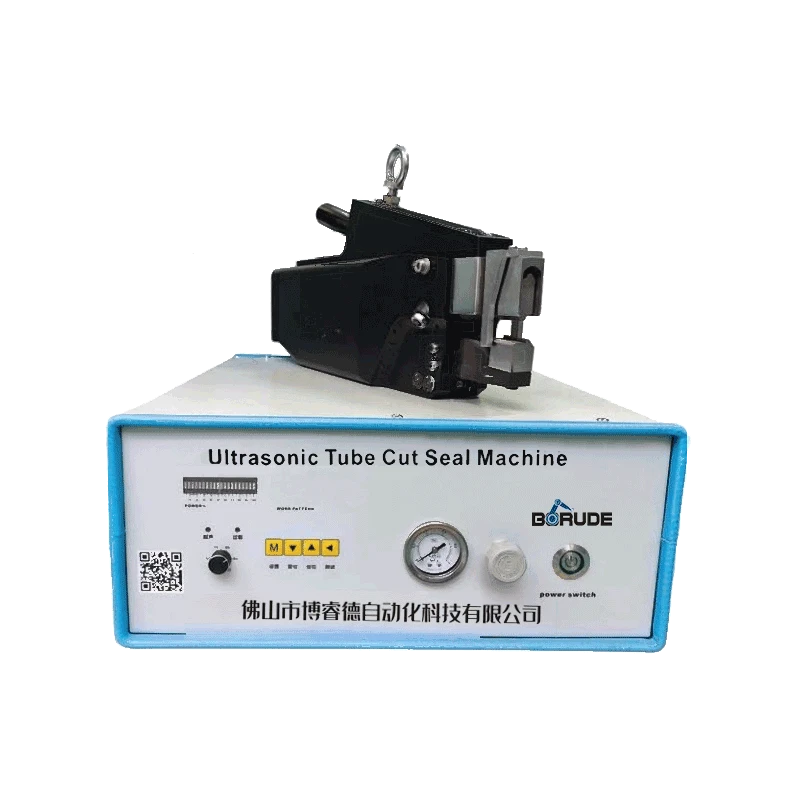
Borude basic edition ultrasonic tube seal machine for pilot and volume heat pump lines
From Sample Trial to Volume Production
A low-risk adoption path looks like this: send Borude your tube samples and schedule a sealing trial; review the weld cross-sections and pressure test results; run a pilot unit beside your charging line for one to two weeks; then standardize parameters and roll out to remaining stations. Because the process is push-button, operators reach full productivity within a single shift, and maintenance is limited to periodic tooling inspection.
As an experienced ultrasonic metal welding equipment manufacturer based in Foshan, China, Borude builds dedicated R290/R600a tube seal machines, supports factory acceptance testing with documented seal data, and ships worldwide with English-language documentation and remote commissioning support.
Ready to De-Flame Your R290 Line?
Whether you are launching a new R290 heat pump platform or upgrading an existing charging line, Borude can validate the sealing process on your tubes before you commit. Contact our engineering team for a sample sealing report, machine quotation and delivery schedule.
Contact Borude — Foshan-based manufacturer of ultrasonic tube sealers, wire splicers and terminal welders for refrigeration, automotive and battery industries.


