


 Home
Home
Ultrasonic Welding for HVAC Heat Exchangers: A Manufacturing Guide | Borude
September. 22,2026
Published by Borude | September 22, 2026 | Ultrasonic Welding Equipment
HVAC heat exchangers — radiators, condensers, evaporators, and coil assemblies — are the thermal heart of air-conditioning, refrigeration, and heating systems. Traditionally, copper tubes and aluminum fins are joined by flame brazing or mechanical expansion. But as energy-efficiency regulations tighten and production lines scale, manufacturers are replacing brazing with ultrasonic metal welding for critical tube-to-tube and tube-to-fin joints. This guide explains why ultrasonic welding is becoming the preferred joining method in HVAC heat exchanger manufacturing, what buyers should evaluate, and how Borude equipment fits modern production requirements.

Ultrasonic copper tube sealing for HVAC and refrigeration applications
Why Heat Exchanger Manufacturers Are Moving Away from Brazing
Flame brazing has served the HVAC industry for decades, but it carries growing liabilities in modern manufacturing environments:
- Open-flame hazard: Brazing requires oxygen-acetylene or propane torches. In facilities handling flammable refrigerants such as R290 (propane) or R600a (isobutane), open flames create ignition risks and trigger strict hot-work permitting.
- Consumable costs: Brazing rods, flux, shielding gas, and tip replacements generate recurring material expenses that scale with production volume.
- Skilled-labor dependency: Certified brazers require months of training. Turnover in this skilled role creates bottlenecks and quality inconsistency.
- Thermal distortion: The 600–800°C brazing temperature anneals copper tubes, weakens thin-wall designs, and can warp delicate fin packs.
- Flux residue: Chemical flux left inside tubes corrodes from the inside out, leading to field failures and warranty claims.
For manufacturers producing thousands of heat exchanger coils daily, these factors compound into measurable cost and risk. Ultrasonic tube sealing eliminates every one of them.
How Ultrasonic Welding Works in Heat Exchanger Production
Ultrasonic metal welding is a solid-state bonding process. A piezoelectric transducer converts high-frequency electrical energy (typically 20–40 kHz) into mechanical vibration. The welding tip (sonotrode) transmits this vibration to the joint interface between two metal workpieces — for example, a copper tube and an aluminum fin, or two copper tube ends in a return-bend assembly.
Under controlled clamping pressure, the frictional energy breaks down surface oxides and asperities. Fresh metal surfaces come into atomic contact, and interdiffusion creates a metallurgical bond — all without melting either base metal. The peak temperature stays well below the melting point, preserving material strength and geometry.
For HVAC applications, this means:
- No filler metal: The bond is formed from the base metals themselves. No brazing alloy means no galvanic corrosion cells at the joint.
- No flux: Internal tube surfaces remain clean, eliminating post-weld flushing and long-term corrosion risk.
- Low heat input: Thin copper tubes (0.3–0.5 mm wall) and aluminum fins retain their mechanical properties and dimensional accuracy.
- Fast cycle time: A typical ultrasonic weld or seal completes in 1–2 seconds — 5–10 times faster than brazing.
- Process monitoring: Modern systems measure weld energy, amplitude, and depth in real time, logging data for traceability.

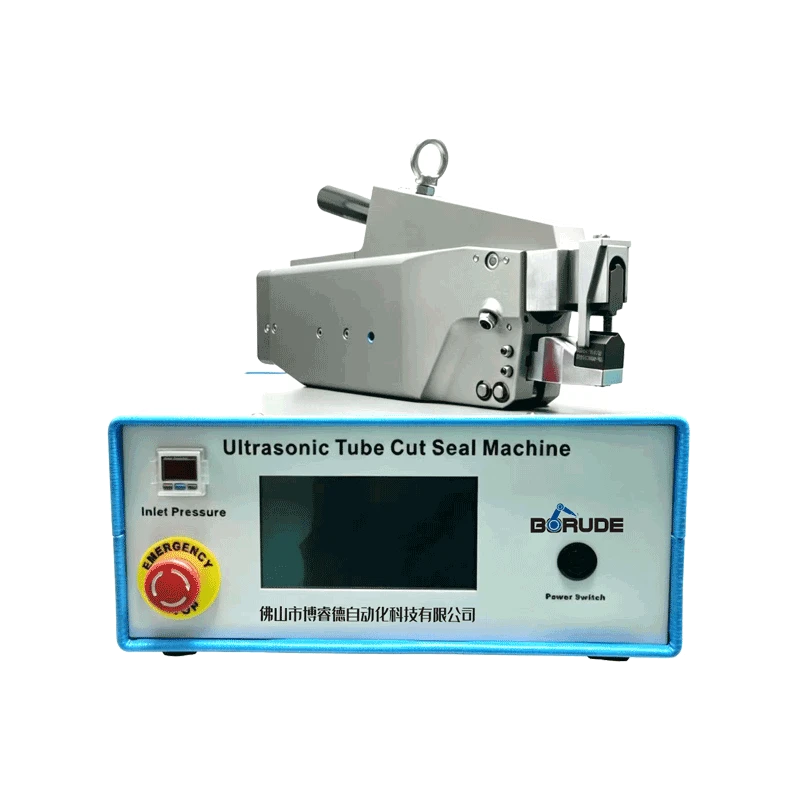
BRD-2A Smart Edition — ultrasonic tube sealing with real-time quality monitoring
Key Applications in HVAC Heat Exchanger Manufacturing
Ultrasonic welding serves multiple joining tasks across the heat exchanger production line:
1. Copper Tube Return-Bend Sealing
After hairpin tubes are bent and inserted through fin packs, the open ends must be sealed or joined to U-bend return fittings. Ultrasonic tube sealers close these tube ends in a single 1-second cycle, creating a hermetic seal without filler metal or flux. The sealed tip can be cut clean for subsequent brazing-free assembly, or left as a permanent process closure.
2. Tube-to-Fin Bonding (Mechanical + Ultrasonic Hybrid)
While mechanical expansion remains common for tube-to-fin joints, ultrasonic welding is increasingly used for critical bond points where thermal conductivity and joint reliability are paramount. The solid-state bond creates a direct metal-to-metal thermal path with no air gaps or flux barriers, improving heat transfer efficiency by 5–15% compared to brazed joints with incomplete filler flow.
3. Header and Distributor Tube Assembly
In multi-circuit coils, inlet and outlet header tubes connect to multiple branch circuits. Ultrasonic welding joins these tube stubs to the main header with precise energy control, preventing the burn-through common in manual brazing of thin-wall distributor tubes.
4. Repair and Rework Stations
Production-line leak testing often reveals a small percentage of defective joints. Ultrasonic portable units allow operators to re-seal or re-weld individual tubes without removing the entire coil from the line — impossible with brazing, which would damage adjacent fins.
5. Aluminum-to-Copper Joints
As manufacturers shift to all-aluminum or copper-aluminum hybrid designs to reduce weight and cost, ultrasonic metal welders provide one of the few reliable methods for joining dissimilar metals without intermetallic compounds that embrittle brazed Cu-Al joints.
What to Evaluate When Sourcing Ultrasonic Welding Equipment for HVAC
Buyers evaluating ultrasonic welding equipment for heat exchanger production should use the following criteria:
Tube diameter range: Ensure the equipment handles your full product range — typically 4–12 mm OD for residential HVAC, up to 16 mm for commercial units. Tooling should be interchangeable for diameter changes.
Wall thickness compatibility: Heat exchanger tubes range from 0.3 mm (micro-channel) to 0.8 mm (heavy-duty commercial). The welder must control amplitude and pressure precisely to avoid crushing thin walls or under-welding thick ones.
Cycle time and throughput: For high-volume coil production, target 1-second weld cycles with automatic part presentation. A line producing 2,000 coils per day with 20 tubes each needs 40,000 seals — achievable only with sub-2-second cycle times.
Process monitoring and data logging: Look for real-time measurement of weld depth, energy, frequency deviation, and air pressure. Automatic alarm and part-reject signaling are essential for zero-defect production.
Tool life and replacement cost: Welding tips wear with cycle count. Ask for rated tip life (typically 6,000–60,000 cycles depending on material and geometry) and replacement cost. Tool compatibility with industry-standard platforms (KM, Kobra) reduces lock-in.
Integration with automation: RS232 or Ethernet communication, PLC compatibility, and digital I/O for robotic part handling enable seamless integration into automated coil assembly lines.
Refrigerant compliance: If your products use A3 (R290, R600a) or A2L (R32) refrigerants, confirm the welding process produces no open flame, spark, or hot slag — ultrasonic welding satisfies this requirement inherently.

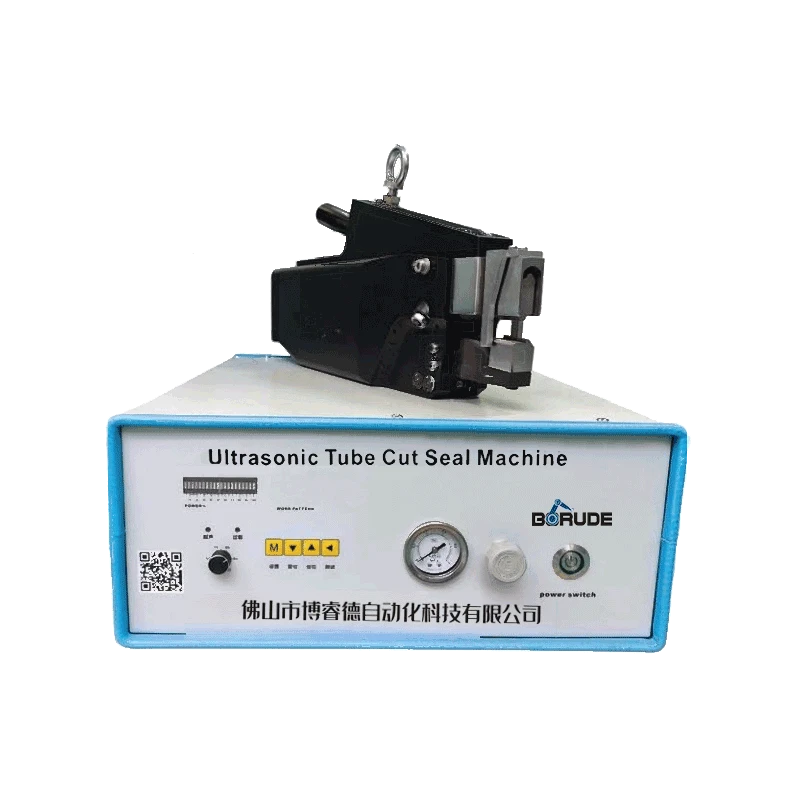
BRD-2M Basic Edition — reliable tube sealing for high-volume HVAC manufacturing
Borude BRD-2A and BRD-2M: Specifications for HVAC Production
Borude offers two ultrasonic tube sealer configurations optimized for heat exchanger and refrigeration manufacturing:
BRD-38000-2A (Smart Edition) — For manufacturers requiring full process traceability and automated quality control:
- Operating voltage: 220V AC / 50Hz
- Air pressure: 0.45–0.6 kgf/cm²
- Real-time monitoring: sealing thickness, air pressure, frequency deviation
- Automatic alarm and defect blocking
- 20 parameter sets stored via 7-inch touchscreen
- RS232 interface for MES/PLC integration
- Welding head weight: 12.5 kg
- Tip life: 6,000 cycles per point; 60,000 cycles total head life
- Compatible with KM and Kobra tooling standards
BRD-38000-2M (Basic Edition) — For cost-sensitive high-volume lines where manual changeover is acceptable:
- Same core welding performance and cycle time (1 second)
- Simplified control interface for operator ease
- Lower capital investment with identical tool compatibility
- Ideal for contract manufacturers and emerging-market producers
Both models share the same fundamental advantages for HVAC and refrigeration production: zero consumables, no open flame, no flux, energy consumption approximately 1/30 of resistance welding, and operation by general workers after brief training.
ROI: What Heat Exchanger Manufacturers Gain by Switching to Ultrasonic
The economic case for ultrasonic welding in HVAC manufacturing rests on four pillars:
1. Elimination of consumables
A mid-size heat exchanger factory consuming 500 kg of brazing alloy and 200 liters of flux annually spends $15,000–25,000 on these materials alone. Ultrasonic welding removes this cost entirely.
2. Labor cost reduction
Certified brazers command premium wages. Replacing 10 brazing stations with ultrasonic units operated by general assembly workers reduces direct labor cost per coil by 30–50%.
3. Throughput increase
At 1 second per seal versus 5–15 seconds for brazing, a single ultrasonic station matches the output of 3–5 brazing stations. Floor space, ventilation, and fire-suppression infrastructure shrink proportionally.
4. Quality and warranty savings
Flux-induced corrosion and brazing voids are leading causes of in-warranty coil failures. Ultrasonic joints eliminate flux residue and provide real-time defect detection, reducing field failure rates by 60–80% in documented implementations.
For a typical facility producing 100,000 heat exchanger coils annually, the payback period on ultrasonic welding equipment investment is typically 8–14 months — after which the savings accrue directly to margin.
Why Borude Is the Right Partner for HVAC Ultrasonic Welding
Borude (Foshan Boruide Automation Technology Co., Ltd.) designs and manufactures ultrasonic metal welding equipment specifically for refrigeration, HVAC, battery, automotive, and solar industries. Our heat exchanger customers choose Borude for three reasons:
Application expertise: We have deployed tube sealers and welders in HVAC production lines across Asia, Europe, and the Americas. Our engineers understand the difference between a residential mini-split coil and a commercial chiller bundle — and we configure tooling accordingly.
Proven compliance: Borude ultrasonic sealing is inherently flameless, making it the safest joining method for A3 and A2L refrigerant systems. Our equipment helps manufacturers meet EN 378, ASHRAE 15, and IEC 60335-2-40 requirements without additional safety infrastructure.
Full lifecycle support: From pre-sales sample welding and parameter development, to on-site installation and operator training, to spare-tip supply and remote diagnostics — Borude supports the full equipment lifecycle. We also offer OEM/ODM customization for unique coil geometries and automated line integration.
Ready to Upgrade Your Heat Exchanger Production Line?
Send us your copper tube samples and production requirements. Our engineers will weld test pieces, optimize parameters, and return a full process report with ROI analysis — at no charge.
Request a Free Welding TrialOr email us at info@borude-sonic.com | Typical response within 24 hours
Related reading: BRD-2A Smart Tube Sealer Specifications | BRD-2M Basic Tube Sealer | Refrigeration Applications | Borude Ultrasonic Welding Equipment


