


 Home
Home
Flameless Copper Tube Sealing for Cold-Chain Repair and Field Service | Borude
September. 17,2026
Every refrigeration technician knows the routine: a supermarket display case or a cold room loses charge, the leak is found, and the final step — closing the copper process tube after evacuation and recharging — still means lighting a torch. In 2026 that routine is under pressure from two directions at once. Facility managers increasingly ban open flames inside occupied food environments, and flammable refrigerants such as R290 and R600a now sit inside the very circuits technicians are asked to close. This guide looks at how cold-chain service providers are solving the problem with a copper tube sealing machine that works without flame, filler metal or hot-work permits — and what to check before adding one to your service fleet.
Why Open Flames Are Disappearing from Cold-Chain Service Work
Brazing a tube closure in a food production area, a supermarket machine room or a cold-storage corridor is very different from brazing on a factory floor. The site is occupied, the surroundings are combustible — packaging, insulation panels, stored goods — and the refrigerant may already be back in the system when the tube is closed. Each of these factors pushes the same conclusion: the flame has to go.
- Hot-work restrictions: Supermarkets, food plants and logistics hubs increasingly require permits, fire watches and assigned extinguishers for any torch work — costs that a small repair visit cannot absorb.
- Flammable refrigerants: R600a in household and commercial cabinets, and R290 in condensing units and chillers, are classified A3. Closing a charged circuit near an ignition source is a risk most EHS managers no longer accept.
- Insurance and audit pressure: After any fire incident, insurers ask what ignition sources were present during maintenance. Documented flame-free procedures are becoming a contract requirement for service tenders.
- Quality on the go: Torch-drawn vacuum seals depend on operator skill. A service technician doing eight repairs a day cannot always reproduce the same bore condition, and oxidized closures become callback leaks months later.
The alternative that has quietly spread through OEM refrigerator lines over the past decade — ultrasonic sealing for refrigeration applications — is now compact enough for service workshops and field-based repair stations.

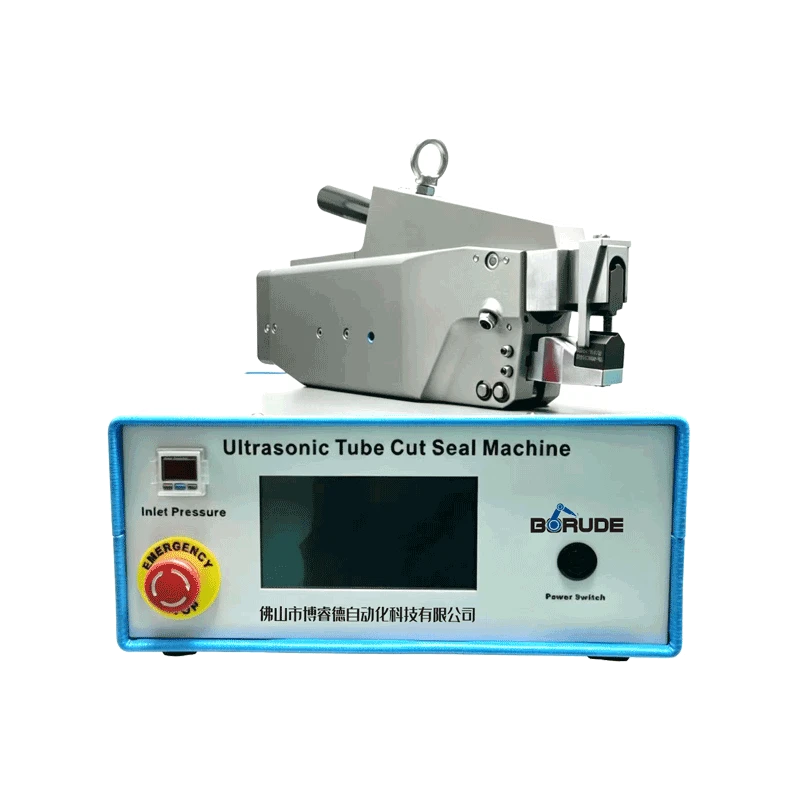
Borude smart edition ultrasonic tube cut & seal machine — flame-free closure of R290/R600a copper tubes
How Ultrasonic Copper Tube Sealing Works in the Field
Ultrasonic tube sealing is a solid-state process. A sonotrode vibrating at ultrasonic frequency presses against the copper tube while a shaped anvil clamps it with controlled force. Intense friction disperses surface oxides and produces a cold weld between the collapsed copper layers — no flame, no brazing ring, no flux. In the same clamping cycle, the tooling shears the tube tail clean off, so cut and seal happen in one station in roughly one to two seconds.
Because nothing melts, there is no ignition source at the most dangerous moment of a repair: the final closure of a charged circuit. The sealed bore is smooth and oxide-free, which matters for callback rates — oxide debris from torch brazing is a known cause of expansion-device blockages after field repairs. Power and infrastructure requirements are modest: a machine such as the Borude BRD-38000-2A runs on 220 V AC with compressed air at 0.45–0.6 kgf/cm², and its 12.5 kg welding head mounts on a service van bench or a compact workshop stand. Energy draw is roughly 1/30 of resistance welding, so the machine works from ordinary site power.
Where Cold-Chain Service Teams Deploy Tube Sealers
Service organizations that have adopted flameless closure typically cover these jobs with one machine:
- Supermarket refrigeration: Display cases and remote racks repaired in trading hours, where torch work is effectively banned around open food areas.
- Cold rooms and cold stores: Evaporator and expansion-valve replacements in insulated envelopes, where a flame near PIR foam panels is a serious fire load.
- Transport refrigeration: Truck and trailer units serviced in depots where multiple flammable-gas cylinders are unwelcome.
- Cabinet refurbishment: Beverage coolers, wine cabinets and freezers re-commissioned after compressor swaps — the classic R600a environment.
- Sensor capillary work: Thin capillary tubes for thermostats and pressure sensors, which are nearly impossible to close cleanly with a torch.
In all five cases the economics follow the same pattern: no hot-work permits, no fire watch, no consumables, and a repeatable closure whose quality no longer depends on who held the torch. For teams comparing an ultrasonic metal welding machine manufacturer for the first time, the decision usually comes down to the checklist below.

Flameless ultrasonic sealing applied to copper tubes in refrigeration service work
Choosing a Copper Tube Sealing Machine for Service Duty
A machine built for a factory line is not automatically right for a service fleet, and vice versa. Use this checklist when comparing a copper tube sealing machine for cold-chain repair duty:
| Criterion | What to Check | Why It Matters in Service |
|---|---|---|
| Tube diameter range | Coverage of 4–8 mm process tubes plus thin capillaries | One machine must serve cabinets, racks and cold rooms alike |
| Cycle time | Seal and cut completed in 1–2 seconds per closure | Keeps trading-hour repairs short and van schedules intact |
| Process monitoring | Real-time checks of sealing thickness, air pressure and frequency with alarms | Gives service managers documented, out-of-tolerance-proof closures |
| Power and air supply | 220 V AC and ~0.45–0.6 kgf/cm² shop air | Runs from ordinary site power; no special infrastructure |
| Consumables | No brazing rings, flux or gas cylinders required | Lower cost per closure and fewer van-stock items to manage |
| Support and training | Commissioning, operator training and wear-part supply from the manufacturer | Keeps every technician, not just the specialist, closing tubes correctly |
Monitoring deserves special emphasis. The Borude smart ultrasonic tube cut and seal machine tracks sealing thickness, pressure fluctuations and frequency deviation in real time and alarms automatically when a closure drifts out of tolerance — turning every field repair into a documented process rather than a matter of trust.

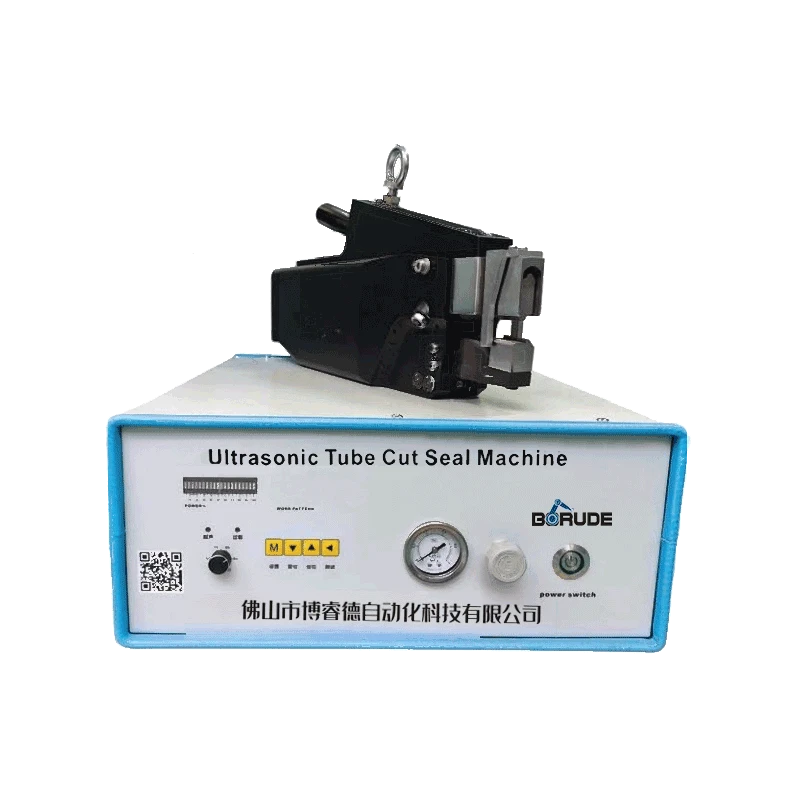
Borude basic edition tube sealing machine — a straightforward entry point for service workshops
Working Safely with R290 and R600a in the Field
A flameless closure does not replace refrigerant-handling discipline — recovery, ventilation and leak checking still follow local codes such as EN 378 or ASHRAE 15 guidance. What it does is remove the largest single ignition risk from the job: the open flame at the moment the circuit is closed and charged. Combined with standard A2L/A3 work practices — grounded equipment, monitored refrigerant concentration in enclosed machine rooms, and recovery before intervention — ultrasonic sealing lets a service company state a simple, auditable fact: no ignition source touches the refrigerant circuit during repair.
That statement is increasingly what facility owners, franchise chains and cold-chain logistics operators want to see in a maintenance contract, and it is already shaping tender documents in European and Asian retail refrigeration markets.
Why Cold-Chain Service Providers Choose Borude
Borude (Foshan Boruide Automation Technology) builds ultrasonic metal welding equipment for refrigeration manufacturers and service organizations worldwide. Service buyers typically start with the basic edition tube sealing machine for workshop duty, then step up to the smart edition when process monitoring and data documentation become contract requirements. The company's range also covers wire splicing, terminal and busbar welding, and induction brazing equipment for jobs where flame remains acceptable — so one supplier can support the whole closure strategy rather than a single tool.
Every machine ships with commissioning support, operator training and wear-part supply, and models are benchmarked against KM and Kobra fittings for straightforward integration into existing service tooling.
Ready to take the flame out of your cold-chain repairs?
Contact Borude for a tube sealing machine recommendation matched to your tube sizes, refrigerants and service volume — including trial sealing on your own tube samples.
© 2026 Borude (Foshan Boruide Automation Technology). Ultrasonic metal welding and tube sealing equipment for refrigeration, automotive and battery manufacturing.


