


 Home
Home
Ultrasonic Welding Tip Maintenance and Troubleshooting Guide | Borude
September. 14,2026
When your ultrasonic metal welder starts producing inconsistent joints, the welding tip is usually the first suspect. Whether you are running a copper tube sealing machine on a refrigeration line or a terminal welding system for battery packs, the sonotrode and anvil are the single most critical wear components. This guide walks production engineers and sourcing managers through real-world maintenance routines, common failure modes, and step-by-step troubleshooting — drawn from Borude's field experience across 200+ deployed ultrasonic welding lines worldwide.
Why Welding Tip Maintenance Directly Impacts Your Bottom Line
The welding tip — also called the sonotrode or horn — transfers ultrasonic vibration energy into the workpiece. As the tip wears, energy transfer becomes uneven. You may not notice a single bad weld, but over thousands of cycles, tip degradation silently erodes first-pass yield, burst strength, and joint consistency. A well-maintained Borude welding head delivers over 60,000 sealing cycles before replacement — twice the industry average — but only if maintenance protocols are followed.
Consider the economics: an unscheduled tip failure on a refrigeration production line running R290 or R600a refrigerants can halt tube sealing for 30 to 90 minutes. On a high-volume appliance line producing 1,200 units per shift, that translates to hundreds of unfinished products piling up. Proactive maintenance costs a fraction of one hour of unplanned downtime.

Understanding Welding Tip Wear: What Actually Happens Over Time
Ultrasonic welding tips fail through several mechanisms. Understanding each one helps you diagnose problems faster and order the right replacement parts before production is affected.
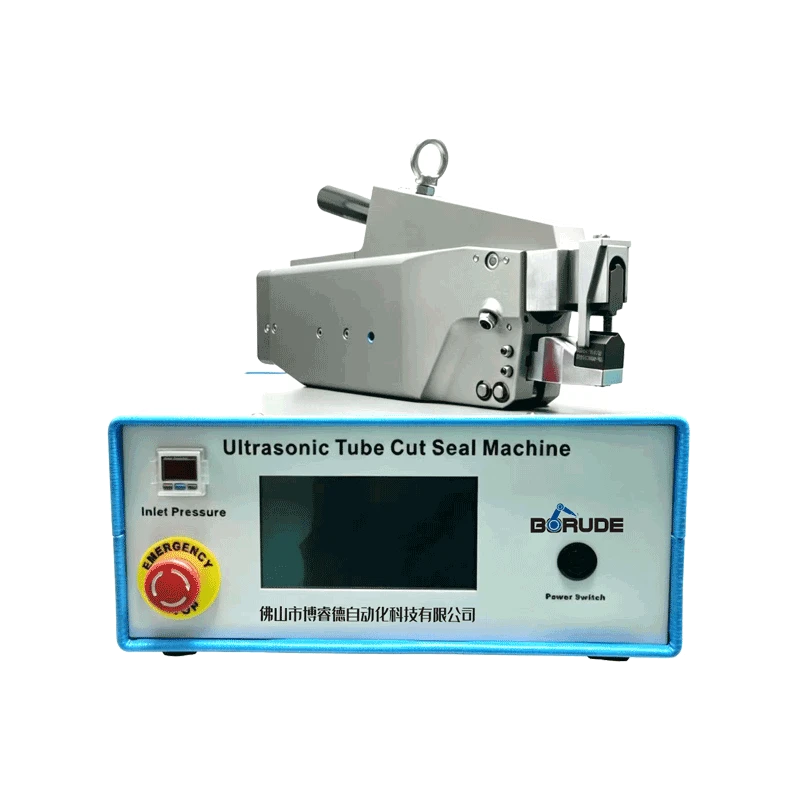
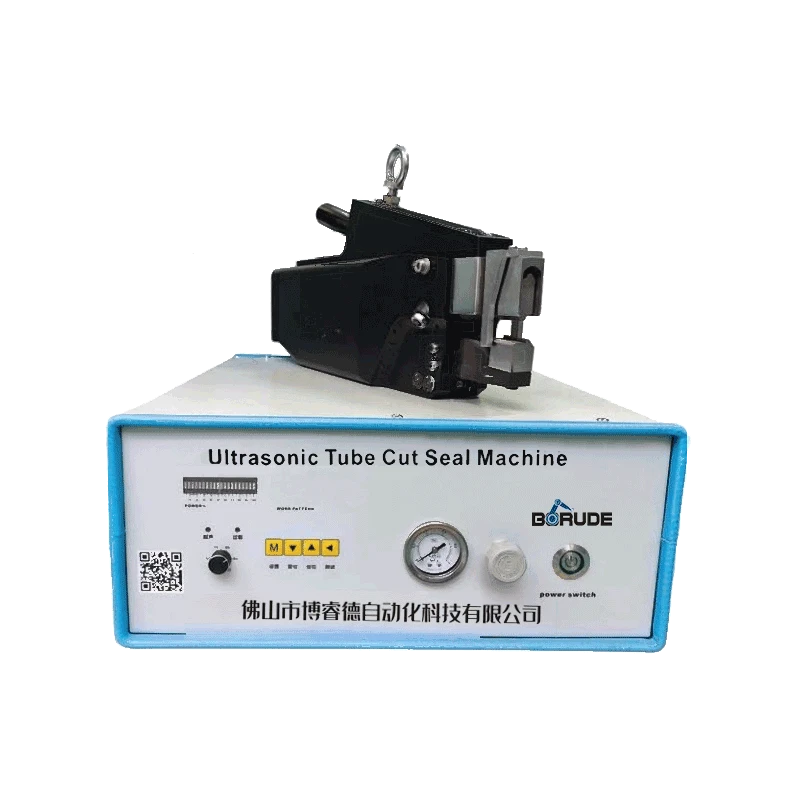
1. Surface Deformation (Tip Flattening). The welding tip face features a precision-machined texture — typically knurling or a contoured profile — that grips and focuses ultrasonic energy onto the workpiece. After thousands of cycles at 20 kHz vibration frequency, this texture gradually flattens. Energy disperses instead of concentrating, producing weaker joints with lower burst pressure. On Borude's BRD-38000-2M tube sealer, the single-point welding tip is rated for 6,000 cycles per tip point, with the total welding head lifespan reaching 60,000 cycles by rotating through multiple points.
2. Cracking and Chipping. Micro-cracks develop at stress concentration points on the sonotrode, especially if the machine is operated outside its rated air pressure range (0.45–0.6 kgf/cm² for the BRD-38000-2A). Cracks propagate rapidly under cyclic loading. A cracked tip produces inconsistent welds and can shatter during operation, potentially damaging the booster and transducer assembly below.
3. Oxidation and Contamination Buildup. Copper and aluminum particles gradually embed into the tip surface during welding. On copper tube sealing applications, oxidized copper residue forms a brittle layer that disrupts vibration transfer. Regular cleaning with a soft brass brush and isopropyl alcohol removes this buildup and restores energy coupling efficiency.
4. Anvil (Lower Tooling) Wear. The lower welding base — the anvil — experiences the same wear mechanisms as the tip. Many operators focus only on the upper sonotrode and forget to inspect the anvil. On Borude machines, the upper cutter and lower welding base are interchangeable and compatible with KM and Kobra series tooling, giving you flexibility in sourcing replacements.
Daily and Weekly Maintenance Checklist
A disciplined maintenance routine dramatically extends welding tip life and prevents the majority of field failures. Here is the protocol Borude recommends for its ultrasonic welding equipment:
| Frequency | Task | Purpose |
|---|---|---|
| Daily (start of shift) | Visual inspection of welding tip face for chips, cracks, or flat spots | Catch physical damage before it affects weld quality |
| Daily (end of shift) | Clean tip and anvil surfaces with brass brush + isopropyl alcohol | Remove embedded metal particles and oxidation buildup |
| Daily | Verify air pressure within rated range (0.45–0.6 kgf/cm²) | Prevent over-pressurization that cracks tips and under-pressurization that weakens joints |
| Weekly | Rotate welding tip to next unused point (multi-point tips) | Distribute wear evenly and extend total head lifespan to 60,000 cycles |
| Weekly | Run test welds on sample tubes and measure burst pressure | Detect gradual quality degradation before it reaches production batches |
| Monthly | Check booster and transducer stack for loose fasteners | Ensure vibration energy transfers efficiently through the acoustic stack |
| Quarterly | Replace welding tip if cycle count exceeds 6,000 per point or visual wear is evident | Maintain weld quality and prevent tip failure during production |
Common Weld Defects and How to Troubleshoot Them
When weld quality drops, the root cause is almost always one of five issues. Here is a systematic troubleshooting approach that production operators can follow without specialized diagnostic equipment.
Defect 1: Incomplete or Weak Seals (Low Burst Pressure)
This is the most common complaint on ultrasonic tube sealing machines. If burst pressure falls below the 50 MPa benchmark, check the following in order:
- Welding tip wear — The most frequent cause. Inspect the tip face for flattening. If the knurl pattern has visibly degraded, rotate to a fresh point or replace the tip.
- Air pressure deviation — Use a calibrated pressure gauge. Even 0.05 kgf/cm² below specification can reduce clamp force below the threshold for solid-state bonding.
- Tube surface contamination — Oil, coolant residue, or heavy oxidation on copper tubes prevents proper molecular interdiffusion. Clean tubes with solvent wipes before welding.
- Anvil wear — If the tip looks fine, inspect the lower welding base for groove formation. Anvil channels deeper than 0.2 mm require replacement or resurfacing.
Defect 2: Tube Deformation or Wall Thinning
Excessive clamp force or prolonged weld time can thin the tube wall at the seal point. The Borude intelligent model BRD-38000-2A features real-time monitoring of sealing thickness with automatic out-of-tolerance alarms. If your machine does not have this feature, manually reduce weld time in 0.1-second increments and re-test burst pressure until you find the sweet spot — typically 0.5 to 1.0 seconds.
Defect 3: Inconsistent Welds Between Shifts
When one shift produces good seals and another does not, the issue is almost always operator technique or setup variation. The BRD-38000-2A stores up to 20 welding recipes accessible via its 7-inch touchscreen, enabling one-click changeover between product types. Ensure all operators select the correct recipe for each tube specification. If problems persist, verify that all shifts are performing the daily tip cleaning protocol.

Defect 4: Sticking or Material Adhesion to Tip
Copper or aluminum material bonding to the welding tip surface indicates that the tip face has lost its anti-stick texture or that the tip temperature is elevated due to excessive weld frequency. Clean the tip surface thoroughly. If sticking recurs after cleaning, the tip face needs resurfacing or replacement. On battery tab welding applications where thin foils are joined, this issue is more prevalent due to the high surface-to-volume ratio of the workpiece.
Defect 5: Machine Alarm — Frequency Deviation
Borude's intelligent models monitor ultrasonic frequency in real time. A frequency deviation alarm typically means the acoustic stack (transducer + booster + sonotrode) has drifted out of resonance. Causes include: a loose sonotrode mounting bolt, a cracked welding tip changing the mass of the resonant assembly, or an incorrectly installed replacement tip. Power down, re-torque all stack fasteners to specification, inspect for cracks, and restart. If the alarm persists, contact Borude technical support for stack impedance diagnostics.
Sourcing Replacement Welding Tips: What Buyers Need to Know
When ordering replacement welding tips and anvils, procurement teams should specify the following to ensure compatibility and performance:
- Machine model — Borude's BRD-38000-2A, BRD-38000-2M, and BRD-38000-7A each use different tip geometries. Confirm the model number on your equipment nameplate before ordering.
- Tube diameter range — Different tube sizes (typically 3 mm to 12.7 mm for refrigeration applications) may require different tip profiles. Borude offers a full range of tip sizes matched to your production specifications.
- Material grade — Standard tips are hardened tool steel. For high-volume or abrasive applications, Borude offers tungsten carbide-tipped options with extended service life.
- KM/Kobra compatibility — If your facility also operates KORMAX or SCHUNK Kobra series equipment, Borude's interchangeable upper cutters and lower welding bases are cross-compatible, simplifying your spare parts inventory.
- Expected cycle life — Standard Borude tips deliver 6,000 cycles per welding point with multi-point rotation extending total head life to 60,000 cycles. Confirm these benchmarks with your supplier and reject tips that fall short.

Why Borude Welding Heads Outlast the Competition
Not all ultrasonic welding tips are created equal. Borude manufactures its sonotrodes from a proprietary high-strength alloy steel formulation, heat-treated to optimize the balance between hardness and fatigue resistance. The result is a welding head that consistently delivers 60,000+ total cycles — double the industry average — while maintaining CPK ≥ 1.33 process consistency throughout its service life.
Beyond tip quality, Borude's intelligent machines provide the monitoring infrastructure that makes proactive maintenance possible. The BRD-38000-2A smart tube sealer tracks sealing thickness, air pressure, and frequency deviation in real time, automatically flagging out-of-tolerance conditions before they produce defective seals. This transforms maintenance from reactive fire-fighting to data-driven prevention — the core of any modern ultrasonic welding production line.
Borude also provides comprehensive after-sales support including systematic operator training, regular equipment maintenance services, and a readily available spare parts inventory. Our technical team maintains sufficient capacity to provide on-site support when needed, ensuring that your production line stays running and your welding tips perform at peak efficiency throughout their service life.
Keep Your Production Line Running at Peak Performance
Need replacement welding tips, preventive maintenance service, or a consultation on upgrading your ultrasonic welding line? Borude's technical team is ready to help you minimize downtime and maximize welding head lifespan.
Contact Borude Today


